
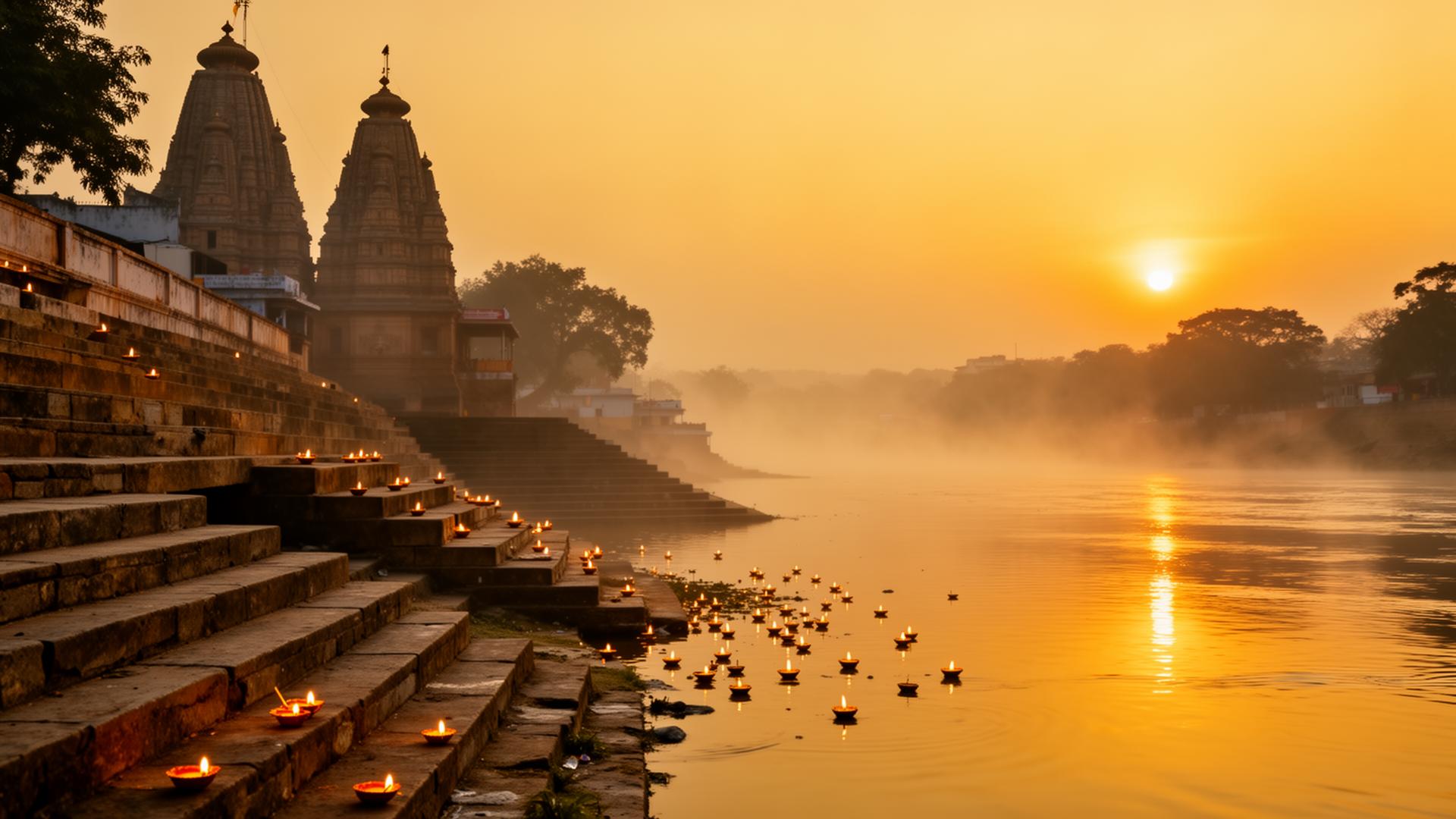
There is a sacred geography to the universe. The human body has a navel — the origin of life, the point where a soul is nourished before it enters the world. The Puranas declare that the Earth, too, has such a navel. That point is Nabhi Gaya, located in Jajpur, Odisha, on the banks of the Vaitarani River — the very river that the Garuda Purana says the departed soul must cross to reach the realm of the pitrs.
This is not mythology for its own sake. It is sacred cartography — a map of spiritual power that the rishis embedded in texts spanning the Skanda Purana, the Brahmanda Purana, the Vayu Purana, the Brahma Purana, and the Mahabharata. Every one of these ancient authorities points to the same conclusion: Nabhi Gaya is the supreme kshetra for Pind Daan, surpassing even the famous Gaya in Bihar for the sheer weight of liberation it grants.
Location
Jajpur, Odisha (125 km north of Bhubaneswar)
Sacred River
Vaitarani (the mythic river of ancestral crossing)
Shakti Peeth
One of the 18 Ashtadasha Maha Shakti Peethas
Merit (Punya)
One pind = merit of a crore Gaya-shraddhas
Generations Liberated
21 kul (generations) — Pitrs + Matrs + 7 past + 7 future
Nabhi Kupa Location
Inside Maa Biraja Temple compound, Jajpur Town
What Is Nabhi Gaya? — Identity and Significance
The name itself holds the entire theology. Nabhi means navel in Sanskrit. Gaya is the most famous Pind Daan kshetra in all of Bharat, in Bihar, where Lord Rama and Sita are said to have performed the shradh of King Dasharatha. To call a place Nabhi Gaya is to declare it as the navel — the supreme origin, the central point — of the Gaya tradition itself.
Nabhi Gaya is not a metaphor. It is a specific, physical sacred site — a well of limitless depth called the Nabhi Kupa, located inside the compound of the Biraja Devi Temple in Jajpur town. The Puranas record that when the universe was created, Lord Brahma performed his primordial Yajna on the banks of the Vaitarani River. The navel of that creation settled here, making this point the umbilical connection between the world of the living and the world of the ancestors.
गयायां पिण्डदानेन यद्यत्पुण्यं लभेन्नरः। तत्पुण्यं नाभिगयायां पिण्डदानेन लभ्यते॥
"Whatever merit is gained by offering Pind Daan at Gaya in Bihar — that very same merit is attained at Nabhi Gaya through a single offering. And here, 21 generations are liberated."
— Skanda Purana, Utkala Khanda
This single shloka is the cornerstone of Nabhi Gaya's supremacy. The famous Gaya in Bihar is revered across all of Bharat and has been a place of pilgrimage for thousands of years. Lord Rama himself performed Pind Daan there for King Dasharatha. And yet the Skanda Purana — the largest of all Puranas — states unequivocally that whatever you gain by performing Pind Daan at Gaya, Bihar, you gain the same at Nabhi Gaya in Jajpur. Through a single offering.
The Sacred Geography — Jajpur, Odisha
The very name of the city encodes its sacred identity. Jajpur derives from the Sanskrit Yajpur or Yagnapur — the city of the Yajna. The Puranas record that Lord Brahma himself performed a primordial Ashwamedha Yajna here, and that the divine energy of that Yajna remains embedded in the earth of this kshetra to this day.
Jajpur is located approximately 125 kilometres north of Bhubaneswar in the Jajpur district of Odisha. It sits on the banks of the Baitarani River — the Vaitarani of the Puranas — which flows through the heart of this sacred town before joining the Bay of Bengal. The town that grew around Maa Biraja's temple was historically known as Viraja Kshetra, and over centuries this evolved into Jajpur.
Key Sacred Sites Within the Jajpur Kshetra
- ◆Nabhi Kupa — The well of infinite depth inside Maa Biraja Temple — the point where Pind Daan offerings are made
- ◆Maa Biraja Temple — One of India's 18 Maha Shakti Peethas; the divine mother who presides over this kshetra
- ◆Vaitarani Ghats — The sacred river banks where Tarpan is performed; the Vaitarani that the soul must cross
- ◆Ishaneswara, Mrityunjyeswara — Shiva shrines within the temple complex that bless the ancestral rites
- ◆Sixty-Four Yogini Shrine — Ancient tantric site; the 64 Yoginis remain in this kshetra permanently by Maa Biraja's decree
- ◆Maa Biraja Ghat — Primary ghat for Tarpan, Pind Daan and ancestral rituals on the Vaitarani
The Vaitarani River — Why It Matters More Than Any Other
Of all the rivers mentioned in Hindu sacred texts in the context of ancestral rites, none carries the weight that the Vaitarani does. The Garuda Purana — the primary scriptural authority on death, the afterlife, and Pind Daan — describes the journey of the soul after death in meticulous detail. It names the Vaitarani as the river that lies on the boundary between the world of the living and the realm of Yama, the god of death.
When a soul departs the body, it begins a difficult 47-day journey toward Yama's domain. Along this path, it must cross the Vaitarani. The crossing of this river is described as extraordinarily difficult for a soul that has not had proper Tarpan, Pind Daan, and Gau Daan performed on its behalf. The soul of the departed literally suffers in this crossing — unless the living descendants have fulfilled their sacred duty.
Now consider the geography of Nabhi Gaya. The Vaitarani flows right through it. When a descendant stands on the ghats of the Vaitarani at Nabhi Gaya and offers Tarpan and Pind Daan, they are performing this rite on the very banks of the river the ancestor's soul must cross. The Garuda Purana and Skanda Purana both confirm this: Tarpan performed at the Vaitarani ghats ferries the pitrs across in person.
वैतरण्यां तु यो दद्यात् तर्पणं पितृभक्तितः। स पितॄन् तारयेत् सर्वान् वैतरण्या उभे तटे॥
"He who offers Tarpan to the ancestors on the banks of the Vaitarani with devotion — ferries all his pitrs safely across both shores of the Vaitarani."
— Garuda Purana, Pretakhanda
This is not a metaphor. In the sacred geography of Sanatan Dharma, the Vaitarani at Nabhi Gaya, Jajpur, is the terrestrial manifestation of the river the ancestors must cross. Performing Pind Daan here is the most direct possible intervention in that crossing.
The Nabhi Kupa — The Well of Infinite Depth
At the very heart of the Biraja Temple compound in Jajpur town lies the Nabhi Kupa — the navel well. This is not merely a symbolic structure. The Nabhi Kupa is a deep sacred well, the bottom of which, according to all traditional accounts, has never been found. The tradition holds that this well is literally the navel (nabhi) of the earth — the point from which the universe was created and to which all creation returns.
It is directly beside Maa Biraja's shrine, inside the main temple complex. When a devotee performs Pind Daan at Nabhi Gaya, the offerings are made at this exact spot — at the edge of the Nabhi Kupa, in the shadow of Maa Biraja, on the banks of the Vaitarani.
The Nabhi Kupa — Sacred Facts
Location: Inside the main compound of Maa Biraja Temple, Jajpur Town, Jajpur, Odisha — PIN 755001. Just 1.5 km from Jajpur town centre.
Physical description: A well of unknown depth — traditional accounts state its bottom has never been found, symbolising its connection to the netherworld (Patala) and the ancestral realm.
Significance: The Puranas declare this to be the actual point of the Earth's navel — the most powerful location for offering Pind Daan in all of Bharat.
Divine proximity: Pind Daan performed at the Nabhi Kupa is done in the direct presence of Maa Biraja — the goddess who presides over all ancestral rites performed in this kshetra.
Maa Biraja — The Shakti Peeth That Sanctifies All Ancestral Rites
Nabhi Gaya is simultaneously one of the most powerful Pitru Tirthas and one of India's most important Shakti Peethas. Maa Biraja — the presiding deity of this kshetra — is worshipped as one of the 18 Ashtadasha Maha Shakti Peethas of Bharat, making this place doubly sacred in a way few kshetras can claim.
According to the Brahmanda Purana, when Lord Brahma performed his primordial Yajna on the banks of the Vaitarani, Devi Parvati emerged from the sacrificial fire in response to Brahma's invocation. Brahma prayed to her and asked her to remain in this kshetra as Biraja — the one who is beyond the manifest world. She agreed, and created Nine Durgas, Sixty-Four Yoginis, and Eight Chandikas to remain in the kshetra permanently. The divine feminine presence she established here is precisely what makes Nabhi Gaya so powerful for ancestral liberation.
When you perform Pind Daan at Nabhi Gaya, the ancestral offerings are not made in an ordinary sacred space — they are made in the direct presence of Maa Biraja, one of the highest manifestations of the divine mother in all of Sanatan Dharma. The Shakti Peeth energy of the kshetra amplifies the power of every ritual performed within it.
नाभिगयायां पिण्डदानेन कोटिगयाफलं लभ्यते। पितरः स्वर्गमाप्नुयुः मातरश्च विमुक्तये॥
"By offering Pind Daan at Nabhi Gaya, one obtains the merit of a crore Gaya-shraddhas. The fathers attain swarga, and the mothers too are liberated."
— Brahmanda Purana
What the Ancient Scriptures Say — Seven Puranas Speak
One of the most striking features of Nabhi Gaya's sanctity is the breadth of scriptural testimony. This is not a regional belief or a local tradition. The holiness of Nabhi Gaya, Jajpur, is attested across no fewer than seven major Puranas and the Mahabharata:
Skanda Purana (Utkala Khanda / Purushottama Mahatmya)
Contains the most detailed account of Nabhi Gaya — explicitly declaring that pind daan here equals a crore Gaya-shraddhas and liberates 21 generations. The Skanda Purana is the largest of all 18 Maha Puranas.
Brahmanda Purana
Describes Brahma's Yajna on the Vaitarani, the emergence of Maa Biraja, and the creation of the divine feminine retinue that makes this kshetra uniquely sacred for ancestral rites.
Brahma Purana
References the Vaitarani, Maa Biraja's kshetra, and the power of ancestral rites performed here. The Brahma Purana is one of the oldest and most authoritative of all Puranas.
Vayu Purana
Explicitly mentions Nabhi Gaya among the most powerful Pitru Tirthas in all of Bharat, alongside Gaya in Bihar and Puri in Odisha.
Mahabharata
The Mahabharata — the greatest of all Hindu epics — references the Vaitarani River and the kshetra of Maa Biraja, lending epic-level authority to the sacred geography of Jajpur.
Kapilasamhita
The Kapilasamhita, a specialized text on Shakti worship, references both Maa Biraja and the ancestral rites performed at Nabhi Gaya as being of supreme potency.
Ashtashakti Texts
Tantric literature consistently identifies Nabhi Gaya as a primary Shakti Peeth — and notes the unique quality of an Oddyana associated with the Vaitarani's location in Odisha.
The Three Holy Gayas — How Nabhi Gaya Compares
In the Sanatan tradition, there are three sacred sites known as the Tri Gaya Kshetras — the three most powerful locations for Pind Daan in all of Bharat. These are:
Most Potent
Nabhi Gaya
Jajpur, Odisha
One pind = crore Gaya-shraddhas. 21 generations liberated. Shakti Peeth energy + Vaitarani Tarpan + Nabhi Kupa.
Gaya (Vishnupada)
Gaya, Bihar
The most famous and ancient Pind Daan kshetra. Lord Rama performed Pind Daan for Dasharatha here. Immense merit.
Pithapuram
Andhra Pradesh
Kukkuteswara kshetra — highly sacred for ancestral rites in South India.
It is significant that among these three, only Nabhi Gaya combines the triple sanctity of being a Shakti Peeth, a Pitru Tirtha, and the site of the terrestrial Vaitarani. This is what gives Nabhi Gaya its extraordinary power — the convergence of three forms of divine energy in a single geographical point.
Why 21 Generations? — The Theology of Liberation
The claim that Pind Daan at Nabhi Gaya liberates 21 generations is not a numerical exaggeration. It emerges from a precise theological understanding of the ancestral realm and the nature of liberation.
The Puranas describe the Pitru Loka (ancestral realm) as having multiple levels — the recently departed, the distant ancestors, and the very ancient ones who have been in the ancestral realm for many generations awaiting liberation. A standard Pind Daan ritual, performed at an ordinary sacred site, reaches primarily the recently departed and, through the power of the mantras, some of the more distant ancestors.
But Nabhi Gaya's power is different in kind, not just degree. The Skanda Purana's declaration that one pind here equals a crore Gaya-shraddhas is a statement about the potency per offering. This extraordinary potency is what allows the liberation to reach not just the immediate ancestors but the entire genealogical chain — both paternal (pitr paksha) and maternal (matr paksha) — up to 21 generations. The calculation of 21 includes:
- ◆Seven generations of paternal ancestors (the seven pitrs of the pitr paksha)
- ◆Seven generations of maternal ancestors (from the mother's lineage)
- ◆The ancestor for whom the specific Pind Daan is being performed
- ◆Three generations going forward — descendants yet to be born, who are freed from ancestral karmic debt
- ◆And the performer himself, who accumulates the punya of this supreme act
या सा वैतरणी नाम त्रिषु लोकेषु विश्रुता । सावतीर्णा गयाक्षेत्रे पितॄणां तारणाय हि ॥ श्राद्धदः पिण्डदस्तत्र गोप्रदानं करोति यः । एकविंशतिवंश्यान् स तारयेन्नात्र संशयः ॥
"The Vaitarani, renowned in the three worlds, descends in Gaya-ksetra for the crossing of the pitrs. One who performs Shraddha, offers pinda and gives go-dana there uplifts twenty-one lineage members; there is no doubt."
— Garuda Purana, Gaya Mahatmya tradition
The phrase "21 kul tar jaate hain" that echoes through Odisha's ancestral tradition is a direct echo of the Skanda Purana's declaration: at Nabhi Gaya, the entire ancestral chain — all 21 — crosses over.
A President's Testimony — The 2026 Affirmation
On February 3, 2026, the President of India, Smt. Droupadi Murmu, made a pilgrimage to Nabhi Gaya, Jajpur, and performed Pind Daan at this sacred kshetra. The President of India — the highest constitutional office of the Republic — chose Nabhi Gaya specifically for her ancestral rites.
This is not merely a political fact. It is a powerful contemporary affirmation of what the Puranas have stated for millennia. When India's head of state chooses Nabhi Gaya as the site to fulfill her most sacred ancestral duty, it confirms the living, unbroken relevance of this kshetra's spiritual power.
Nabhi Gaya has not merely survived through the ages as a theoretical sacred site. It remains, in the 21st century, the most powerful living Pind Daan kshetra in all of Bharat.
Historical Depth of Nabhi Gaya
4th–5th Century CE: Historians date the emergence of Jajpur as a pilgrimage centre to the Gupta period. The Biraja idol inside the temple is believed to date to the Gupta Dynasty's reign.
9th Century CE: During the reign of the Bhaumakara kings, the region flourished as a major spiritual centre. Tantric traditions identified it as the oldest Tantrik Peetha in Odisha.
Medieval Period: The town's medieval name — Viraja Kshetra — was widely used in inscriptions, temple records, and royal charters. Successive dynasties protected and patronised the temple.
Modern Era: The Biraja temple is administered by the Odisha government and remains one of the most visited pilgrimage sites in the state year-round, with a massive influx during Pitru Paksha.
The Pind Daan Ritual at Nabhi Gaya — Step by Step
Pind Daan at Nabhi Gaya is a structured vidhi — a precise ritual science with specific steps, each of which serves a distinct purpose in the ancestral liberation process. Here is how an authentic Nabhi Gaya Pind Daan unfolds:
Sankalp — The Sacred Declaration
The ritual begins with the Sankalp — a formal declaration of intent before the deity and the sacred fire. The descendant states their own name, gotra, and the name and gotra of the ancestor for whom the Pind Daan is being performed.
Snan — Sacred Bath in the Vaitarani
The descendant bathes in the Vaitarani River before performing the ritual. This bath is not merely physical purification — it is a symbolic entry into the sacred boundary of the ancestral realm.
Tarpan — Offering of Water and Sesame
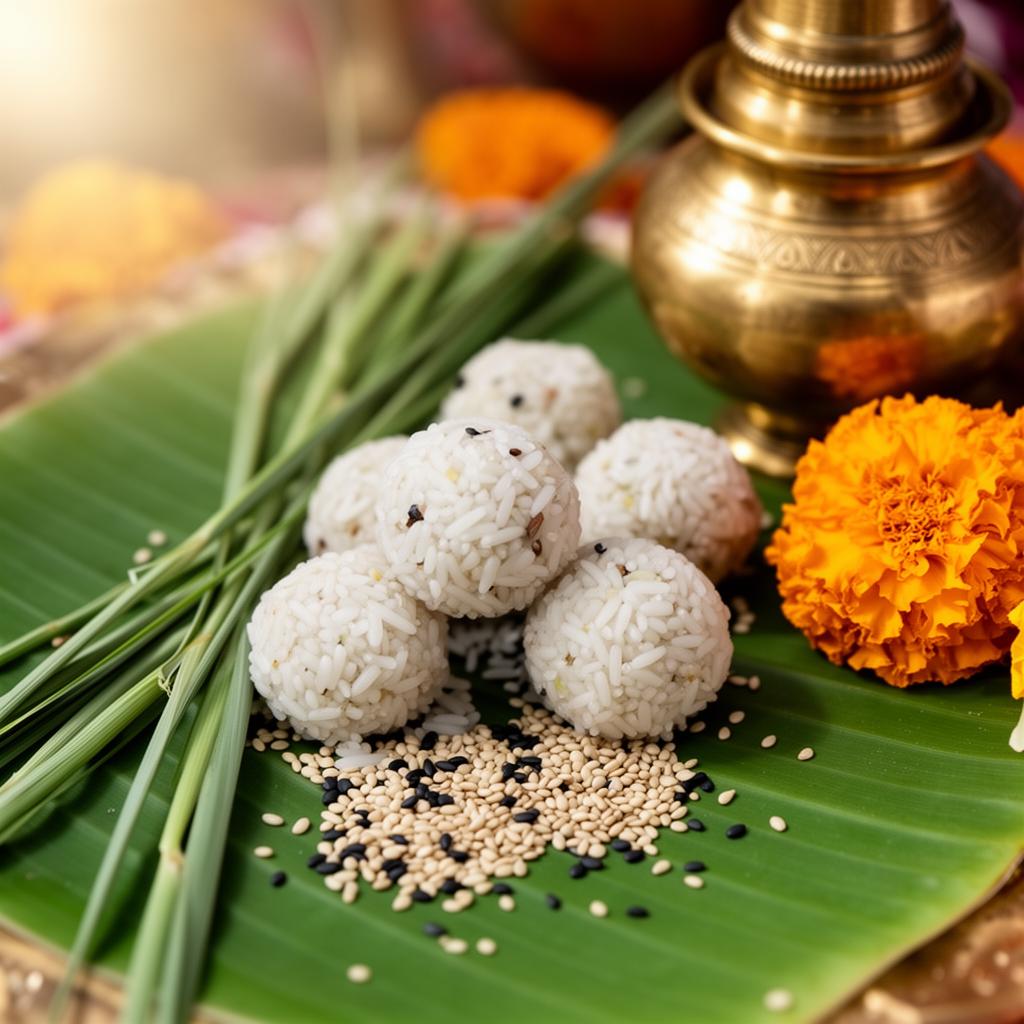
Tarpan is the offering of water mixed with til (sesame seeds), kusha grass, and sacred mantras. It is performed facing south on the Vaitarani ghats. Each offering of water, directed to a specific ancestor by name, provides nourishment to the soul in the ancestral realm.
Pind Offerings — The Body of Nourishment
The Pindas — balls made of rice, barley, sesame, honey, ghee, and kusha grass — are prepared according to precise Vedic specifications. They are offered at the Nabhi Kupa with the appropriate mantras, providing the ancestor with a body of nourishment for their onward journey to liberation.
Gau Daan — The Lifetime Sacred Offering
No Pind Daan is complete without Gau Daan. A cow is donated in the ancestor's name — not as a one-time transaction but as a lifetime commitment. The Garuda Purana is explicit: the cow helps the ancestor cross the Vaitarani.
Brahmin Bhojan and Dakshina
Brahmins — representatives of the divine on earth — are fed a Sattvik meal and given Dakshina. This feeding of Brahmins is considered the most direct path to the satisfaction of the ancestors: when the Brahmin is satisfied, the pitr is satisfied.
Visarjan — Release into the Sacred Waters
The Pindas are finally offered into the Vaitarani River — released back into the cosmic waters from which all life comes and to which all life returns. This Visarjan completes the ritual circuit.
Pitru Paksha at Nabhi Gaya — The Most Auspicious Window
While Pind Daan can be performed at Nabhi Gaya throughout the year on any Amavasya or auspicious tithi, the most powerful window is Pitru Paksha — the fortnight of the waning moon in the month of Bhadrapada (typically September). During this period, the ancestral realm is said to be closest to the living world, and every ritual performed carries amplified potency.
The Puranas describe Pitru Paksha as the time when the ancestors themselves descend to earth, hovering near their descendants' homes, hoping to receive the nourishment of Tarpan and Pind Daan. When a descendant performs these rites at Nabhi Gaya during Pitru Paksha, the combination of the kshetra's perpetual power and the season's amplified receptivity creates a window of extraordinary spiritual opportunity.
During Pitru Paksha, Nabhi Gaya draws devotees from across India and the world. The Vaitarani ghats are alive with the sound of Vedic mantras, the smell of ghee and sesame, and the palpable weight of a thousand families fulfilling their deepest ancestral duty.
How to Reach Nabhi Gaya, Jajpur
By Air
Nearest airport: Bhubaneswar (BBI) — 125 km. Direct taxis and AC buses available.
By Train
Jajpur-Keonjhar Road railway station is 12 km from Jajpur town. Major trains from Kolkata, Bhubaneswar, Puri stop here.
By Road
NH-16 (Kolkata–Chennai highway) passes through Jajpur district. Well-connected by bus from Bhubaneswar, Cuttack, and Puri.
Nabhi Kupa Location
Inside Maa Biraja Temple compound, Jajpur Town — 1.5 km from Jajpur town centre.
Best Time to Visit
Pitru Paksha (Sep–Oct), any Amavasya, or after a family member's passing.
Accommodation
Multiple Dharamshalas and hotels in Jajpur town. Sahi Pinddaan arranges Sattvik lodging near the kshetra.
Begin the Seva
Arrange Your Nabhi Gaya Pind Daan
Sahi Pinddaan arranges authentic, scripture-aligned Pind Daan at Nabhi Gaya, Jajpur — complete arrangement including lodging near the kshetra, Sattvik meals, sankalpit Vedic Brahmins, Tarpan at the Vaitarani ghats, Pind Daan at the Nabhi Kupa, and pure lifetime Gau Daan. Proxy Pind Daan with live video also available for families who cannot travel.
Available daily · 7 AM – 9 PM IST · Shastra-approved Proxy Pind Daan also available