
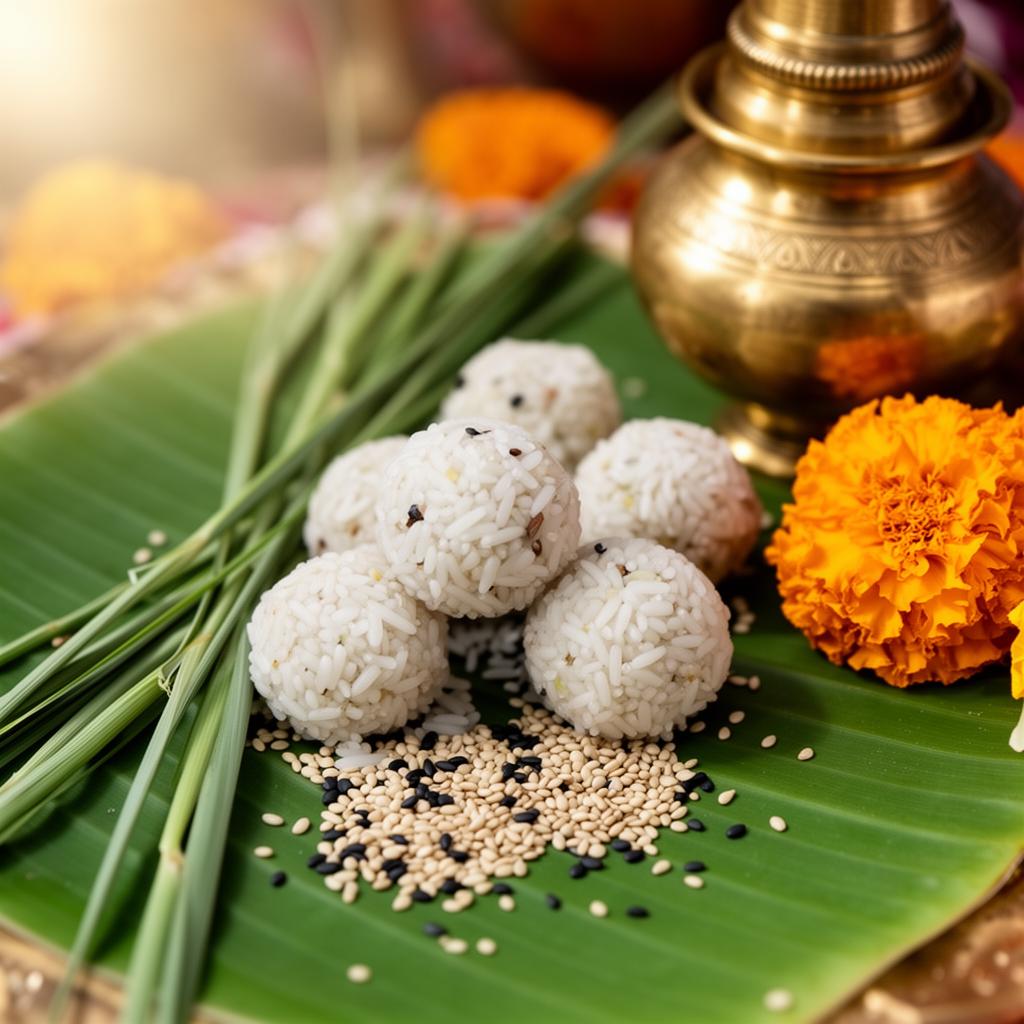
The safest way to speak about Pind Daan is not to depend on hearsay. A serious seva must stand on shastra, living temple tradition, and careful wording. The Shrimad Bhagwat Mahapuran does not give a full ritual manual like the Garuda Purana or Dharma-shastras, but it clearly accepts Shraddha, pinda, preta-kriya, pitru-tarpan, sacred pilgrimage, qualified recipients, sattvic offerings, and Hari-centered performance of ancestral duty.
Research position
The Bhagavata establishes the dharmic foundation. Garuda Purana and Gaya Mahatmya provide the more specific Pind Daan and Gaya-ksetra details. Temple traditions such as Deba Deepawali and Shraddha Besha at Jagannath Puri show how Pitru Seva is preserved as living practice.
What the Shrimad Bhagwat Mahapuran Directly Supports
Direct proof of water and pind offerings
सत्राजितोऽनपत्यत्वाद् गृह्णीयुर्दुहितुः सुताः । दायं निनीयापः पिण्डान् विमुच्यर्णं च शेषितम् ॥
"Because Satrajit had no son, his daughter's sons should inherit after first offering water and pindas, clearing debts, and then taking what remains."
— Shrimad Bhagwat Mahapuran 10.57.37
Bhagwan Narasimha asks Prahlad to perform preta-kriya
कुरु त्वं प्रेतकृत्यानि पितुः पूतस्य सर्वशः । मदङ्गस्पर्शनेनाङ्ग लोकान्यास्यति सुप्रजाः ॥
"Even after Hiranyakashipu was purified by the Lord's touch, Bhagwan Narasimha instructed Prahlad to perform the proper rites for his departed father."
— Shrimad Bhagwat Mahapuran 7.10.22
Shraddha for parents and ancestors
कुर्यादपरपक्षीयं मासि प्रौष्ठपदे द्विजः । श्राद्धं पित्रोर्यथावित्तं तद्बन्धूनां च वित्तवान् ॥
"One should perform Shraddha for one's father and mother according to means; if able, one may also perform it for their relatives."
— Shrimad Bhagwat Mahapuran 7.14.19
Offerings to pitrs become imperishable in sacred time
एषु स्नानं जपो होमो व्रतं देवद्विजार्चनम् । पितृदेवनृभूतेभ्यो यद्दत्तं तद्ध्यनश्वरम् ॥
"Bathing, japa, homa, vrata, worship, and what is given to pitrs, devas, people and beings in sacred times becomes imperishable in merit."
— Shrimad Bhagwat Mahapuran 7.14.25
Gaya and pitru worship in Balarama's pilgrimage
गोमतीं गण्डकीं स्नात्वा विपाशां शोण आप्लुतः । गयां गत्वा पितॄनिष्ट्वा गङ्गासागरसङ्गमे ॥
"During pilgrimage, Bhagwan Balarama bathed in sacred rivers, went to Gaya, worshipped the pitrs, and then proceeded to Ganga-sagara."
— Shrimad Bhagwat Mahapuran 10.79.11
Shraddha should not become display or excess
द्वौ दैवे पितृकार्ये त्रीनेकैकमुभयत्र वा । भोजयेत्सुसमृद्धोऽपि श्राद्धे कुर्यान्न विस्तरम् ॥
"Even a wealthy person should not make Shraddha unnecessarily elaborate. The focus is right time, right place, right faith, right offering and right recipient."
— Shrimad Bhagwat Mahapuran 7.15.3
Sattvic Shraddha, not violence
न दद्यादामिषं श्राद्धे न चाद्याद्धर्मतत्त्ववित् । मुन्यन्नैः स्यात्परा प्रीतिर्यथा न पशुहिंसया ॥
"One who understands dharma should not offer or eat meat in Shraddha. Sattvic offerings bring higher satisfaction than violence."
— Shrimad Bhagwat Mahapuran 7.15.7
The Vaishnava principle behind all offerings
यथा तरोर्मूलनिषेचनेन तृप्यन्ति तत्स्कन्धभुजोपशाखाः । प्राणोपहाराच्च यथेन्द्रियाणां तथैव सर्वार्हणमच्युतेज्या ॥
"As watering the root nourishes the branches, worship of Achyuta fulfills all worship. Pitru-karma is strongest when performed in Hari-smriti and prasada-bhava."
— Shrimad Bhagwat Mahapuran 4.31.14
Mukunda-sharanagati and pitru-rina
देवर्षिभूताप्तनृणां पितॄणां न किङ्करो नायमृणी च राजन् । सर्वात्मना यः शरणं शरण्यं गतो मुकुन्दं परिहृत्य कर्तम् ॥
"One who has fully taken shelter of Mukunda is no longer a debtor to devas, rishis, beings, relatives, humanity or pitrs. This is the highest devotional principle, not a denial of Shraddha-dharma for householders."
— Shrimad Bhagwat Mahapuran 11.5.41
Garuda Purana: Gaya, Pind Daan, Vaitarani and 21 Lineage Members
The Garuda Purana is one of the most important sources for death rites and the journey of the departed. In its Gaya Mahatmya material, the text connects Gaya, pinda-pradana, Vaitarani, go-dana and upliftment of lineage. This is why a serious Pind Daan article should not treat Gaya references as generic; they are part of the core shastric framework.
या सा वैतरणी नाम त्रिषु लोकेषु विश्रुता । सावतीर्णा गयाक्षेत्रे पितॄणां तारणाय हि ॥ श्राद्धदः पिण्डदस्तत्र गोप्रदानं करोति यः । एकविंशतिवंश्यान् स तारयेन्नात्र संशयः ॥
"The Vaitarani, renowned in the three worlds, descends in Gaya-ksetra for the crossing of the pitrs. One who performs Shraddha, offers pinda and gives go-dana there uplifts twenty-one lineage members; there is no doubt."
— Garuda Purana, Gaya Mahatmya tradition
आत्मजो वा तथान्यो वा गयाकूपे यदा तदा । यन्नाम्ना पातयेत्पिण्डं तं नयेद्ब्रह्म शाश्वतम् ॥
"Whether by one's son or by another qualified person, the pinda offered at Gaya-kupa in the name of a departed soul carries that soul toward the eternal Brahman-state."
— Garuda Purana, Gaya Mahatmya tradition
Why this matters for proxy or sankalpit rites
The point is not that anybody can casually replace the descendant. The point is that shastra recognizes named, sankalpit offering. Therefore, when travel, health or circumstance prevents presence, the ritual must be performed by a qualified, accountable Brahmin with correct sankalpa, gotra, name, place and vidhi.
Nabhi Gaya, Viraja and the 21-Generation Claim
For Nabhi Gaya, the strongest wording should be careful: Garuda Purana gives the broad Gaya/Vaitarani/21 lineage principle, while the Vayu Purana's Gaya Mahatmya tradition is especially important for the Viraja, Nabhi-kupa and Jajpur connection. Until an exact Sanskrit page scan is attached, the site should avoid inventing Sanskrit and should cite it as a printed-source research note.
Safe wording for Nabhi Gaya
"Garuda Purana establishes the Gaya-ksetra, Vaitarani and twenty-one lineage principle. Vayu Purana's Gaya Mahatmya tradition connects Viraja/Nabhi-kupa with this ancestral upliftment. This is why Nabhi Gaya is treated in Odisha's living tradition as one of the most powerful ksetras for Pind Daan."
Jagannath Puri: Where the Lord Himself Honors Ancestors
Jagannath Puri adds a unique theological dimension. The argument is not only that Puri is sacred, or that Swargadwar is powerful. The deeper point is that Srimandir preserves the tradition of Deba Deepawali and Shraddha Besha, where Bhagwan Jagannath is understood to honor His divine parents and the royal devotees connected to His manifestation.
This should be presented as temple tradition unless an exact Niladri Mahodaya, Madala Panji or Record of Rights citation is available. With that discipline, the point becomes more powerful: Puri is the ksetra where Pitru Seva is not merely a human duty; it is modeled in the Lord's own tradition.
Best use on the website
Use this point on the Jagannath Puri article as a highlighted research section. On the homepage, keep it as a short teaser linking to the full article so the first screen stays clean and the detailed proof lives where readers expect research.
The Sahi Pinddaan Standard
The Bhagavata warns against excess and empty display. The Garuda Purana emphasizes correct pinda, tarpan, Gaya-ksetra and go-dana. The Puri tradition centers the Lord Himself. Taken together, the standard is clear: right place, right vidhi, right sankalpa, right recipient, sattvic offering, transparent seva and Hari-smriti.
Begin the seva
Arrange a scripture-aligned Pind Daan with the right vidhi.
Speak directly with the family coordinating the seva. We will confirm the ksetra, sankalpa, gotra, ancestor details, samagri, Brahmin arrangement and complete schedule before the ritual.